Showing posts with label Ojibwe. Show all posts

Thursday, December 8, 2016

Annamarie Gutsch - Much More Than Just an Exhibit: Why Treaties Matter Works

Annamarie Gutsch is best known for her work with the Minnesota Indian Affairs Council, having served as Executive Director from 2006-2015. She celebrates a long career in public service to the American Indian Tribes and communities and the people of Minnesota as a Government Relations Director for the Red Lake Nation. She has also worked for the Minnesota Department of Human Rights, for Veterans Affairs, and at the Office of the Revisor of Statutes. Annamarie serves on the Minnesota Humanities Center’s Board of Directors and was instrumental in creating the traveling exhibit Why Treaties Matter: Self-Government in the Dakota and Ojibwe Nation.

UPDATE: “Why Treaties Matter” is now on permanent display at the Minnesota State Capitol in St. Paul. For more information, visit: www.treatiesmatter.org.

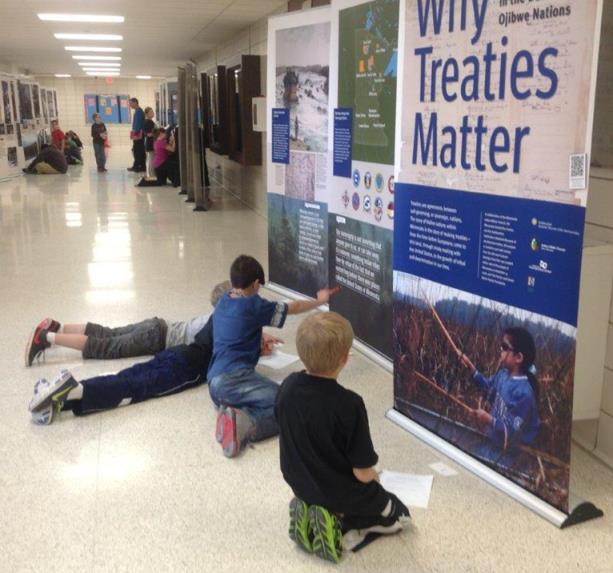
Why Treaties Matter: Self-Government in the Dakota and Ojibwe Nation is a nationally recognized, award-winning, traveling exhibit made in partnership with the Minnesota Indian Affairs Council, the Minnesota Humanities Center, and the Smithsonian’s National Museum of the American Indian. This exhibit explores relationships between Dakota and Ojibwe Indian Nations and the U.S. government in this place we now call Minnesota, focusing on, how treaties affected the lands and lifeways of the indigenous peoples of this place, and why these binding agreements between nations still matter today.

Within our time to create, there always seemed to be an even more profound time to silently reflect and think – time to stretch our minds beyond why we were creating a project with ongoing deep reflection to envision exactly what we were trying to portray to our audience. What was our goal? We wanted to change Minnesota’s dismal understanding of our American Indian communities and create a hunger to learn more while perhaps creating new relationships in a way never accomplished before. With this goal in mind, the greatest collaboration I’ve ever participated in — the Why Treaties Matter exhibit — was born.

From start to the finish, the Why Treaties Matter collaboration and exhibit run, several members of the development team--consisting of me and a core group of outstanding Humanities Center program directors and administrators--spent endless hours of vision-building time together. Time spent sitting around a table, coffee or some beverage and snacks nearby, papers strewn about, where we pondered the simplest or the most complex ideas or thoughts, or, just ripped apart raw details in an agenda for an upcoming program. This was far more than just your everyday nine-to-five working group. It was a group on a mission; a mission that we often proclaimed was “to change the world.” This team of inspiring leaders seemed the perfect group of individuals whose eyes, when mixed together, could see far beyond what most people are capable of envisioning. And as we gathered, it became clear to me that this magnetic force drawing our visions together was truly one that would lead to great success.


The Why Treaties Matter exhibit success wasn’t due to any one person’s academic or intellectual abilities or because we were equipped with greater administrative capacity or even money to turn out such a successful exhibit and programming. It was truly a recipe with healthy doses of eager world changers coming together to contribute their collective knowledge and stories. Most importantly, we were not necessarily the masters of the knowledge but more like the gatherers of it. The true master creators and voices of this project were the cultural leaders, elders, and community members who led this initiative. They came together with us, to sit around the table and helped create a tangible, truth-filled exhibit that has successfully moved towards changing how treaties and the history around them are viewed by both native and non-native people.

The Why Treaties Matter exhibit has touched over 67,200 lives since 2011. For an exhibit that existed well beyond its imagined time to tour various venues across Minnesota for six total years, that’s some spectacular record. What is even more profound is that out of the countless pairs of eyes and minds that gathered information from this rich visual and personal learning experience, most had likely never seen or heard any of this before. Although we knew this was the case, the responses were still overwhelming to us. Email after email proclaimed, “Why haven’t I heard this history before?” Think about that. The real history and story of the lives of our American Indian/indigenous people to this land and most people have never heard anything of it before. This is why we so steadfastly held to our claim that we would “change the world.” As we embark on the seventh year of this remarkable journey, I like to think in a small but profound way that we did.

To learn more about this exhibit, view this exhibit on line and, access accompanying educator guides visit treatiesmatter.org.


Thursday, January 28, 2016

Frank Bibeau - Why Treaties Matter and Wild Rice

Frank Bibeau is a member of the Minnesota Chippewa Tribe, Pillager Band, enrolled at White Earth, and he has lived in Ball Club, Minnesota on the Leech Lake Reservation with his wife Vicki for more than 30 years. He is an attorney who works extensively with Chippewa treaty rights, civil rights, and sovereignty on and off reservation. Frank currently works with Honor the Earth, a native-led, non-profit environmental protection group, and he recently became the Executive Director for the 1855 Treaty Authority.

Wild rice, or Manoomin as it is called by the Anishinabe (Chippewa), is our most sacred or spiritual food and the most central, pivotal part of our culture.

All my life I knew I was an Indian because that was the explanation my (non-Indian) mother gave to a lot of (non-Indian) people as to why I had such a good tan. My father is the Indian — as was his father, my Grandfather. Growing up outside Washington, DC in the late 60s and 70s, I remember that my Grandfather in Ball Club, Minnesota always made sure we had wild rice. It was usually Dad who cooked the wild rice. We always had it in the house but ate it sparingly as we just had a few pounds. So I understood wild rice was as precious to have . . . as to eat.

Full Circle
What I have learned is wild rice is part of our migration and creation stories. We were guided by the Creator to where the food grows on the water. Wild rice is integral to our survival and way of life. Wild rice is the one gift we usually have to share and everyone loves to receive. We need to protect wild rice, and it will always protect us.

More simply translated, wild rice grows in the air, the water, and earth; and therefore wild rice is the ‘canary in the coal mine’ for environmental issues. In honor of that, while at the Public Utilities Commission meeting to discuss a pipeline company’s attempt to avoid an Environmental Impact Statement — a petition denied by the Minnesota Supreme Court — I made sure to thank the three attorneys who appealed for this environmental review that will help protect Minnesota’s wild rice. As I gave them wild rice gathered this year up near Bowstring and processed in Ball Club, it impressed me to see how so many non-Indian people are coming to understand the significance — both cultural and environmental — of wild rice, as well as the importance of treaty rights.Although working to protect Minnesota’s Manoomin and our treaty rights will continue, one thing I know is certain:  I’m getting to be an old Indian in Ball Club who makes sure my Dad and other family and friends have wild rice, because it is important to me too.

Thursday, August 27, 2015

Dakota and Ojibwe Educator Guides and Virtual Exhibit Tour Now Available Online

In a partnership with the Minnesota Indian Affairs Council, a group of Dakota and Ojibwe scholars and educators developed educator guides that enhance the Why Treaties Matter: Self-Government in the Dakota and Ojibwe Nations exhibit content. This traveling exhibit - now available online - focuses on treaties between Dakota and Ojibwe Nations and the U.S. Government. Each guide includes teacher background, student readings and activities, vocabulary, and suggested resources.


Guides explore:
  • A Deep Connection to Place
  • An Ojibwe Narrative: Reconnections to Place
  • Ways of Learning: An Ojibwe Childhood
  • The Chippewa National Forest
  • Traditional Anishinaabe Economy
  • Treaty Economy
  • We Have Always Been Sovereign Nations
In August 2010, a resolution creating a unique partnership of the Minnesota Indian Affairs Council, the Minnesota Humanities Center, and the Smithsonian's National Museum of the American Indian in Washington, D.C. was approved by the Minnesota Indian Affairs Council and made it possible for development of the Why Treaties Matter traveling exhibit as an educational tool for Minnesota audiences.

Educator guides are available at TreatiesMatter.org.
I learned a lot about the Dakota and Ojibwe's past, how they were impacted by the settlers coming here, not just by how the settlers were impacted by them. I also learned about the Dakota and Ojibwe peoples' traditions and cultures, and how they interpret the world. - 9th grade student, Eden Prairie High School

Thursday, April 30, 2015

Treatiesmatter.org -- Absent Narrative Resource of the Month

Today, treaties continue to affirm the inherent sovereignty of American Indian nations. Tribal governments maintain nation-to-nation relationships with the United States government. Tribal nations manage lands, resources, and economies, protect people, and build more secure futures for generations to come.

Treatiesmatter.org allows people to explore the traveling exhibit, Why Treaties Matter, view more than forty related videos, and download Educator Guides for use in the classroom.

Want to visit the exhibit in person? View complete tour dates and exhibit locations at mnhum.org/treaties.

Thursday, January 15, 2015

Dakota and Ojibwe Educator Guides and Virtual Exhibit

In partnership with the Minnesota Indian Affairs Council, a group of Dakota and Ojibwe scholars and educators developed educator guides that enhance the Why Treaties Matter: Self-Government in the Dakota and Ojibwe Nations exhibit content. This traveling exhibit - now available online - focuses on treaties between Dakota and Ojibwe Nations and the U.S. Government. Each guide includes teacher background, student readings and activities, vocabulary, and suggested resources.

Guides explore:
  • A Deep Connection to Place
  • An Ojibwe Narrative: Reconnections to Place
  • The Chippewa National Forest
  • Traditional Anishinaabe Economy
  • Treaty Economy
  • We Have Always Been Sovereign Nations
In August 2010, a resolution creating a unique partnership of the Minnesota Indian Affairs Council, the Minnesota Humanities Center, and the Smithsonian's National Museum of the American Indian in Washington, D.C. was approved by the Minnesota Indian Affairs Council and made it possible for development of the Why Treaties Matter traveling exhibit as an educational tool for Minnesota audiences.

Educator Guides are available at TreatiesMatter.org.
I learned a lot about the Dakota and Ojibwe's past, how they were impacted by the settlers coming here, not just by how the settlers were impacted by them. I also learned about the Dakota and Ojibwe peoples' traditions and cultures, and how they interpret the world.
- 9th grade student, Eden Prairie High School
Students at Walker-Hackensack-Akeley School District, 2014